Microneedling vs RF Microneedling
Microneedling vs VirtueRF Microneedling: Which Treatment Is Right for You?
If you have been looking into skin rejuvenation treatments in Bangkok, you have probably come across both microneedling and RF microneedling. They are two of the most popular minimally invasive options available, and for good reason: both stimulate your skin's own collagen production to improve texture, firmness, and tone, without surgery and with minimal disruption to your routine.
But they are not the same treatment, and choosing the right one depends on what your skin actually needs. At SKNN Clinic Bangkok, we offer both traditional microneedling and VirtueRF, one of the most advanced RF microneedling systems available. This guide gives you a clear, honest breakdown of how each one works, what each one does well, and how to decide which is right for you.
What Is Traditional Microneedling?
Traditional microneedling uses a medical-grade dermapen device fitted with fine needles to create thousands of controlled micro-channels in the skin's surface. These tiny punctures trigger the skin's natural wound-healing response, stimulating collagen and elastin production in the treated area.
The result is gradual improvement in skin texture, tone, and firmness, as new collagen fills in the treated tissue over the weeks following each session. Microneedling is also well established for improving the absorption of topical serums applied immediately after treatment, as the micro-channels allow active ingredients to penetrate more deeply than they would through intact skin.
Traditional microneedling is particularly effective for:
• Overall skin tone and texture refinement
• Fine lines and early surface wrinkles
• Enlarged pores
• Mild acne scarring and uneven skin surface
• Mild pigmentation irregularities
• Boosting product absorption with targeted serums
Redness after traditional microneedling typically lasts 24 to 48 hours, and the skin may feel sensitive for a day or two. Most patients return to normal activities the day after treatment.
What Is RF Microneedling? And What Makes VirtueRF Different?
RF microneedling takes the foundations of traditional microneedling and adds a second layer of action: radiofrequency energy is delivered through the needles directly into the dermis. This creates two separate stimuli at once. The micro-channels trigger surface-level collagen induction; the RF heat triggers deeper tissue contraction and remodelling that standard microneedling cannot reach on its own.
The result is a more pronounced tightening effect, deeper structural improvement, and greater impact on moderate to significant laxity and scarring.
At SKNN Clinic, we use VirtueRF for all RF microneedling treatments. There are several RF microneedling devices on the market, including Morpheus8, Potenza, and Sylfirm X. VirtueRF stands apart in a few important ways:
Robotic Precision Delivery (RPD): the needles are inserted using a proprietary robotic system that ensures smooth, exact insertion with no tearing or trauma to the skin. This is a meaningful comfort advantage over standard RF microneedling pens, which can cause more bruising and irregular channel quality
RF sub-pulse technology: rather than delivering RF energy in one large pulse, VirtueRF breaks it into smaller, precisely timed sub-pulses. This allows the same total energy to be delivered more comfortably and more evenly
36 gold-coated needles: gold coating reduces electrical resistance at the needle tip, improving energy precision and minimising epidermal heating
Adjustable depth and energy: treatment depth can be customised from 0.1mm to 6mm, allowing the clinician to address surface concerns and deeper tissue in the same session
Post-treatment Microcurrent Dual Face Mask: every VirtueRF session at SKNN is paired with this exclusive recovery mask, which soothes the skin and reduces redness so most patients leave with only a mild glow rather than visible redness
VirtueRF is effective for:
Moderate to significant skin laxity
Deeper wrinkles and loss of facial contour
Moderate to severe acne scarring
Skin firming across the face, neck, and chest
Enlarged pores and overall skin quality improvement
Delicate areas, including under the eyes, around the mouth, and the jawline, using a single-needle precision handpiece
How They Compare: A Clear Overview
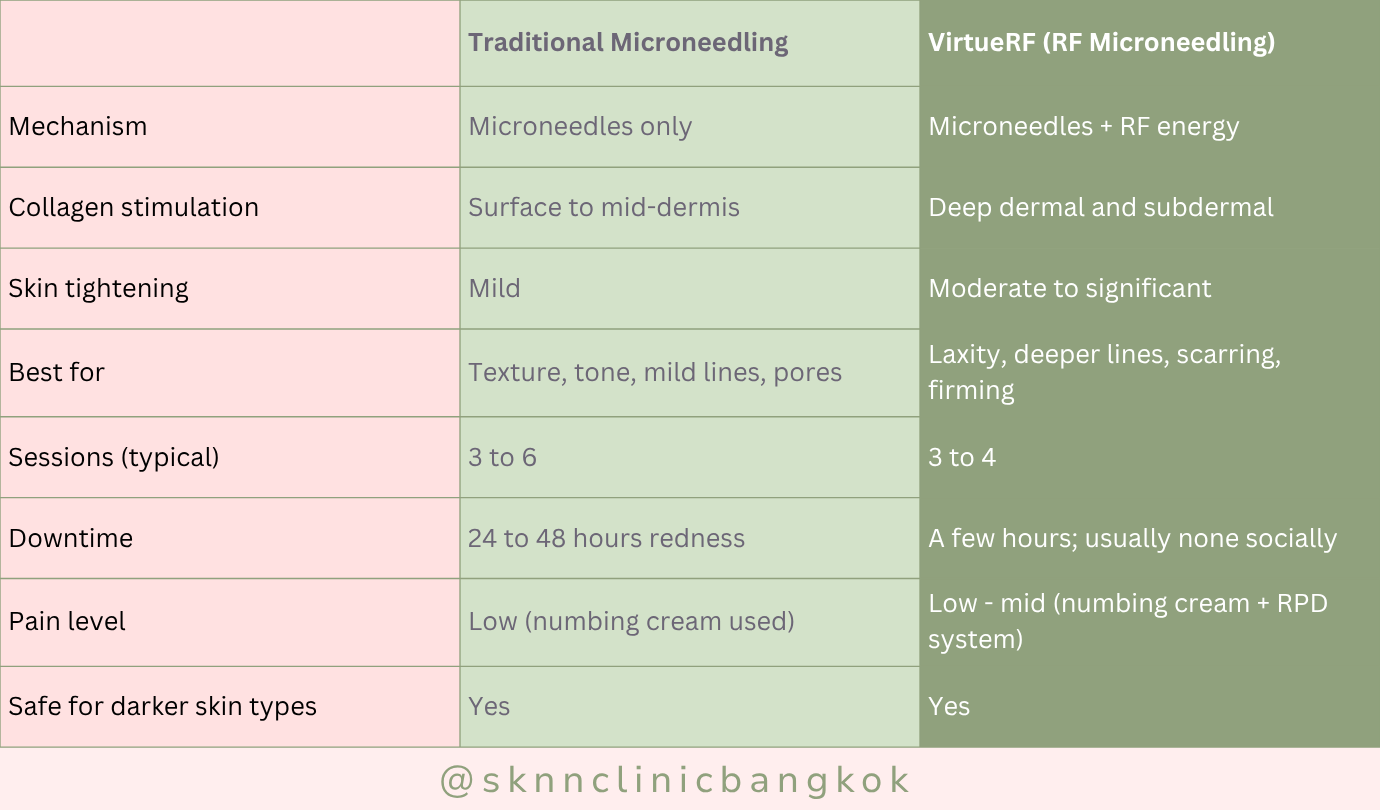
Here is a side-by-side summary to make the distinction concrete. Note that the right choice is never solely about which is more advanced. It depends on your specific skin concerns and goals.
Microneedling vs RF Microneedling at SKNN
Which Treatment Is Right for You?
Both treatments are safe and effective. The decision comes down to what your skin needs and what you are trying to achieve.
Traditional Microneedling Is Likely the Right Starting Point If:
• Your primary concern is overall skin texture, tone, or radiance rather than firmness or laxity
• You have mild concerns, such as early fine lines, minor acne scarring, or enlarged pores
• You are new to skin treatments and want to start with a well-established, straightforward approach
• Budget is a consideration and you want a cost-effective option with good results for surface-level concerns
• You want to pair your treatment with a targeted serum for enhanced absorption
VirtueRF Is Likely the Better Choice If:
• You have noticeable skin laxity, particularly along the jawline, cheeks, or neck
• Your concern is deeper wrinkles or lines that have not responded to lighter treatments
• You have moderate to severe acne scarring
• You want more significant or faster results, and are combining treatments as part of a broader skin health plan
• Minimal social downtime is important to you, as VirtueRF typically resolves to a mild glow within a few hours
• You have a darker skin tone and want to avoid light-based treatments, as VirtueRF uses radiofrequency rather than laser or light energy and is safe for all skin tones
Many patients at SKNN Clinic use both treatments as part of an ongoing plan: VirtueRF for deeper structural work and periodic microneedling for skin quality maintenance in between. Your doctor will advise on the approach that makes sense for your skin and your timeline.
What to Expect From Each Treatment
Traditional Microneedling: Before, During, and After
Before your session, your doctor will assess your skin and apply a topical numbing cream to ensure your comfort. The dermapen treatment itself takes 20 to 30 minutes. You may feel mild pressure and a warm tingling sensation during the procedure.
Afterwards, the skin will appear red, similar to mild sunburn, and may feel sensitive for 24 to 48 hours. You should avoid direct sun exposure, active skincare ingredients such as retinol and AHAs, and makeup for the first 24 hours. Most patients are back to their normal routine the day after treatment.
For optimal results, a course of 3 to 6 sessions spaced 4 to 6 weeks apart is typically recommended. Results build progressively as new collagen develops.
VirtueRF Microneedling: Before, During, and After
A topical numbing cream is applied before your VirtueRF session. The treatment takes approximately 30 to 40 minutes for the face, and the robotic precision delivery system makes the experience noticeably smoother than standard RF microneedling devices.
Most patients notice only mild redness that subsides within a few hours, with no social downtime. Some patients experience mild warmth or sensitivity for 24 hours.
You will likely notice early improvements in skin texture and a brightening effect within a few weeks. Deeper tightening and collagen remodelling continue over 8 to 12 weeks. A course of 3 to 4 sessions spaced 4 to 6 weeks apart is typically recommended, with maintenance sessions once a year.
Frequently Asked Questions
Does microneedling really work?
Yes. Traditional microneedling with a medical-grade dermapen has a strong clinical track record for improving skin texture, reducing pore size, softening mild scarring, and stimulating collagen production. Results depend on the concern being treated, the number of sessions completed, and the quality of the device and technique used. It is a well-established treatment for most skin types.
What is the key difference between microneedling and RF microneedling?
Traditional microneedling creates micro-channels in the skin to trigger surface-level collagen production. RF microneedling, as with VirtueRF, adds radiofrequency energy through those same channels into the deeper dermis. This RF heat triggers a second layer of tissue contraction and remodelling that standard microneedling cannot reach. The result is more pronounced tightening and deeper structural improvement, particularly for laxity and moderate scarring.
How is VirtueRF different from Morpheus8?
Both are RF microneedling devices, but they differ in delivery and comfort. VirtueRF uses a robotic precision delivery (RPD) system that inserts needles smoothly without tearing and breaks RF energy into sub-pulses for more even and comfortable delivery. Many patients and clinicians report VirtueRF is more comfortable than Morpheus8, with less post-treatment redness and bruising. VirtueRF also includes an exclusive post-treatment mask that further reduces visible redness after the session.
Does RF microneedling hurt?
At SKNN Clinic, a topical numbing cream is applied before all microneedling treatments. Most patients find VirtueRF comfortable, describing the sensation as mild warmth or pressure. The robotic precision delivery system is a meaningful comfort advantage over standard RF devices. Sensitivity varies between individuals, and your clinician can adjust settings based on your comfort.
How much does microneedling cost in Bangkok?
At SKNN Clinic, traditional microneedling starts from THB 5,380, depending on which serum is selected for your treatment. VirtueRF RF microneedling starts from THB 16,000 for the full face. We offer packages that include additional treatment areas such as the neck and chest. Please contact us for current promotions.
What is the downtime after each treatment?
After traditional microneedling, redness typically lasts 24 to 48 hours and the skin may feel sensitive for a day or two. After VirtueRF, redness usually resolves within a few hours for most patients, and the post-treatment mask helps further. Most VirtueRF patients return to normal activities the same day.
How many sessions do I need?
For traditional microneedling, a course of 3 to 6 sessions is typically recommended for optimal results. For VirtueRF, most patients complete 3 to 4 sessions spaced 4 to 6 weeks apart. Many patients see noticeable improvement from a single session, but a full course delivers the most significant and lasting results. Your doctor will advise based on your individual skin concerns.
Is microneedling safe for all skin types?
Yes. Both traditional microneedling and VirtueRF are safe for all skin tones when performed by a trained clinician. Because VirtueRF uses radiofrequency energy rather than light, it does not interact with melanin, making it a particularly good option for patients with darker skin tones who want to avoid the pigmentation risk sometimes associated with laser-based treatments. At SKNN Clinic, your doctor will assess your skin thoroughly before recommending a treatment protocol.
Can I combine microneedling with other treatments?
Yes, and for many patients a combined approach delivers the best results. VirtueRF pairs well with ULTRAcel Q+ HIFU for patients who want both deeper structural lifting and surface skin quality improvement. Traditional microneedling can also be used alongside Botox and skin boosters for a more complete skin health routine. Your doctor will advise on what combinations are appropriate and how to sequence them.
Book a Consultation at SKNN Clinic Bangkok
The best way to determine which microneedling treatment is right for you is a proper skin assessment with one of our doctors. We will take time to understand your concerns and goals, assess your skin, and give you a clear recommendation with realistic expectations.
We are located on Sukhumvit Soi 22, between BTS Asoke and BTS Phrom Phong (MRT Sukhumvit). Contact us to book your consultation.